The Three Ingredients of Strategic Execution

Updated: 5 days ago
The Leadership Test Kitchen is a newsletter where I share the real ingredients behind leading and growing successful companies. Some editions feature practical frameworks from CEOs who’ve mastered challenges in strategy, culture, and growth. Others share the lessons I’ve learned firsthand as a CEO, or insights I’ve gained from my work with other executives.
Every few weeks, I’ll use this space to spotlight other accomplished leaders. Today, I’m featuring George Stringer, President of The Lighting Group Seattle, a leading Pacific Northwest lighting agency that represents top lighting and control brands across Washington and Southeast Alaska.
How George Stringer outperformed his market for 5 years running
I recently sat down with George in our Vistage Worldwide CEO Group to talk about strategic execution. Not the theory of strategy, but how it actually gets done inside a growing company.
George’s approach has helped his team achieve nearly double-digit growth in an industry declining by about 10% annually, while building a culture where people are aligned, committed, and clear on the company’s annual goals.
Over the past five years, this execution discipline has allowed The Lighting Group to consistently outperform the market.
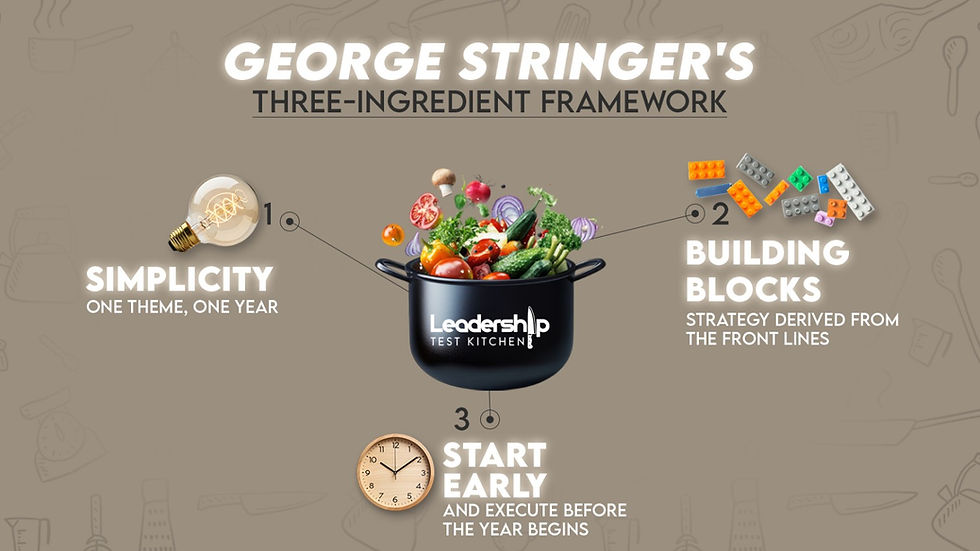
George’s Three-Ingredient Framework
The Lighting Group has grown into a sub-$100M business with a 32% market share, despite significant headwinds. Here’s how George approaches execution:
1. Simplicity: one theme, one year
George starts off the strategic planning cycle with a short word or phrase that brings together market conditions, growth strategy, and team performance.
2025 was the year of "Gain Share". 2026 is the year of "Momentum".
He chooses something so concise that everyone can remember. And everything his team does hangs off of that. The underlying principle is simple: if people can't remember it, it's too complex. Every initiative, decision, and conversation ladders back to that theme.
2. Building Blocks: Strategy Derived from the Front Lines
Rather than designing a strategy from the top down, George pulls it up from the front lines. Front-line leaders each propose 3–5 Annual Growth Initiatives (AGIs). George looks for patterns, then assembles a roundtable of front-line leaders to narrow those ideas down to 3–5 company-wide AGIs.
These initiatives focus on new growth beyond the core business. Because the ideas originate from the people closest to customers and operations, buy-in is built in before the plan is finalized.
Front-line leaders see opportunities and obstacles that executives often miss. When they own the strategy, they drive execution.
3. Start Early and Execute Before the Year Begins
The AGIs selected have a front-line leader assigned, as well as funding, plans, and metrics, before the year ends. The entire company's bonuses are factored into the plan for the year, which includes these AGIs. Finally, he turns to his VP of Finance to set an aggressive monitoring and adjustment cadence.
And this is all done before the ball drops in Times Square. Execution is already in motion before the year even starts.
As Q1 and Q2 unfold and market conditions inevitably change, George can champion necessary pivots without undermining accountability or buy-in, because the system is already working.
This approach has enabled The Lighting Group to outperform its market five years in a row.
Key Takeaways for CEOs
Be the Champion, not the Banker: Delegate architecture, oversight, and monitoring to other leaders in the organization. As CEO, focus on momentum, barrier removal, and coaching, and let others handle project management.
One theme beats five priorities: Shoot for a single word or a single phrase. Choose ‘catchy’ over ‘clever’. If your team can’t repeat it, they won’t execute it.
Embrace intelligent failure: Not every initiative will work. Pivot instead of punish. You’ll unlock bolder thinking and faster learning.
Invite timelines; don’t assign them: When leaders propose their own timelines, accountability sticks.
Fold winning initiatives into the core business: Today’s growth experiments should become tomorrow’s operating model. It sends a message that we are always building on what we do today.
A Culinary Footnote
Those of you who know me personally know I am always looking for parallels between business and my other passion, cooking. My conversation with George Stringer kept bringing me back to lasagna, because the best strategy, like the best lasagna, comes from committing to the fundamentals.
The freshest ingredients. Radical simplicity. Starting early. And patience, giving everything the time it needs to come together.
I never liked Mom’s lasagna growing up (sorry, Mom). Making lasagna completely from scratch, including the pasta, is officially on my culinary checklist for 2026. My Italian cooking bibles, The Essentials of Classic Italian Cooking and Il Cucchiaio d’Argento (The Silver Spoon), are already waiting on the shelf.
Until then, I’ll keep sharing what I’m learning from leaders like George, leaders who
know that building something that lasts starts with getting the basics right.
Originally published on Linkedin on February 3, 2026.
Subscribe to Leadership Test Kitchen to get notified as new editions are released.


Comments