Four Notes to Building a High-Growth Creative Firm

Updated: 5 days ago
The Leadership Test Kitchen is a newsletter where I share the ingredients behind leading and growing successful companies. Some editions feature practical frameworks from CEOs who’ve mastered challenges in strategy, culture, and growth. Others share the lessons I’ve learned firsthand as a CEO, or insights I’ve gained from my work with other executives.

An Afternoon with Amy Wolf, CEO and Founder of Evo3
Every few weeks, I use this space to spotlight accomplished leaders. Today I'm featuring Amy Wolf, CEO and Founder of Evo3 Marketing, a marketing and events firm that is redefining what it means to create a brand experience for some of the largest technology companies in the world — and a fitting spotlight for Women's History Month.
Amy is one of the CEOs I am privileged to support through my Vistage CEO coaching work, and she is one of the most original thinkers I've had the pleasure of sitting across from.
Here's what makes her story especially compelling: Amy is a classical piano instructor. The discipline, craft, and artistry she honed at the keyboard are the very same forces driving Evo3's rapid ascent.
How does a classical piano instructor build a fast-growing, creative marketing firm?
How does she land some of the world's largest technology platforms as customers?
How does she consistently see what’s on the horizon before anyone else does?
It starts with four notes.
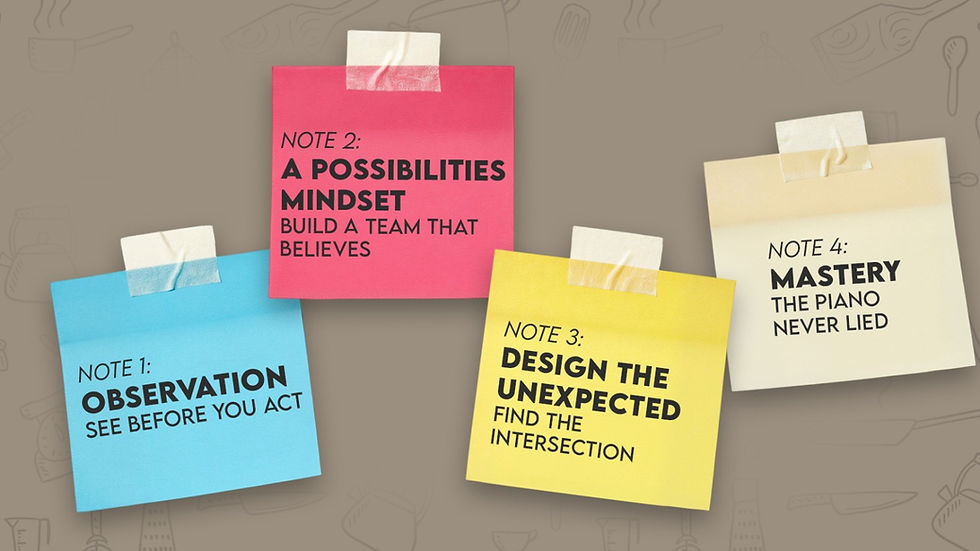
Note 1: Observation — See Before You Act
Finding a market opportunity begins long before any business plan. For Amy, it starts with watching and listening.
Amy is a voracious consumer of information – news, books, political trends, and conversations. She pays close attention to how the world is moving, not just how it looks today. That attentiveness gave her the vision for what would become Evo3: she noticed that some of the world's largest technology platforms were piecing together their marketing materials, swag, and event design from a fragmented collection of vendors. Each vendor solved one piece of the puzzle, but no one was solving for the whole picture.
In that fragmentation, she saw a white space—an opportunity to create a seamless, end-to-end brand experience that would help technology leaders convey their vision and values to the people who matter most: their employees, customers, and partners. She also saw that, by and large, her competitors were transactional. They could execute a branded event. What they couldn’t do was deeply understand the business drivers and values of the leaders they were serving.
That distinction would become Evo3's north star.
The takeaway: Market opportunities rarely announce themselves. They reveal themselves to those curious enough to look — and patient enough to listen.
Note 2: A Possibilities Mindset — Build a Team That Believes
Great observation means little without a team equipped to act on it. Amy has built Evo3’s culture around what she calls a “Possibilities Mindset” — a deeply held belief that there is always a way forward, and that the team’s job is to find it.
She selects her people carefully, screening for curiosity, humility, and what she describes as a “hunter-like” drive to help other people be the heroes of their stories. She reminds her team often that even the most influential leaders of the most powerful companies are human beings – with their own aspirations, needs, and uncertainties. That reminder keeps the team grounded and empathetic rather than intimidated or transactional.
Curiosity fuels possibilities. When her team takes the time to genuinely understand her customers’ business goals — and the personal goals of the individual leader steering that business — they can find paths to elevate a brand and a vision that go far beyond a well-branded water bottle and a flawlessly catered event. The creativity and courage to try something different comes from trust, built relationship by relationship, with a little humor and humility thrown in.
The takeaway: Mindset is contagious. Build a team that sees possibilities where others see limits, and you've built a competitive advantage that's very hard to copy.
Note 3: Design the Unexpected — Find the Intersection
This is where Evo3 earns its reputation.
The most common mistake in event and marketing design is making it about the company. Amy designs an end-to-end experience around the individual leader sponsoring an event or initiative. She looks for the intersection of three things: what the leader personally needs to communicate and achieve, what the company’s brand platform stands for, and where both of those points lie in the future. “Delight”, as she puts it, lives in that intersection — and delight is what gets people talking.
The result is a branded experience that doesn’t just look polished, but feels personal and intentional. It feels like it could only have been made for this company, this leader, this moment. That is an extraordinarily difficult thing to manufacture. For Amy’s team, it is the work.
The takeaway: The real edge does not lie in the company brand, but in customization at the individual leader level. The companies that get there first will win.
Note 4: Mastery — The Piano Never Lied
This is perhaps the most underappreciated ingredient, and the one that separates good operators from great ones.
Before Evo3, Amy spent years as a successful classical piano instructor. And anyone who has ever seriously studied a musical instrument knows: the instrument doesn't negotiate with you. It tells the truth. Either the technique is right, or it isn't. Either the preparation was thorough, or it wasn't. There is no shortcut to a clean performance.
That same standard lives at the heart of Evo3. Amy brings to her business the same discipline she brought to the keyboard — the commitment to mastery. Repetition, feedback, and refinement are the foundation on which trust is built, and trust is what allows her team to take creative risks and shoot for the moon.
The parallels run deeper than discipline. A skilled pianist listens — not just to herself, but to the full composition. She understands how her part fits into a larger whole. That same instinct shapes how Amy approaches client relationships: she hears what leaders are saying and what they aren't saying, and she builds experiences that honor both. And just as a pianist must master the fundamentals long before she improvises, Amy's team earns the right to creative boldness through the unglamorous work of getting the basics consistently right.
No task is beneath anyone on the team. Everyone has an opportunity to be better than they were yesterday. That culture of mastery is, ultimately, what makes the big swings possible.
The takeaway: The discipline to do the small things right is what earns you the permission — and the confidence — to try something extraordinary.
Key Takeaways for CEOs
Start with observation, not ideation. The best business ideas don't emerge from brainstorming sessions. They emerge from paying deep, sustained attention to where friction lives in the market.
Hire for curiosity and humility first. Skills can be developed. A genuine desire to make someone else the hero of their story is much harder to teach.
Find the intersection. The most memorable experiences live at the crossroads of the personal, the brand, and the future. Design for that, not for the average.
Master the fundamentals before you innovate. Creative risk-taking is only possible when your team has earned trust through consistent, disciplined execution. The piano never lies — and neither does your clients' experience of working with you.
Use your network as a discovery tool. Amy's closing advice to other entrepreneurs: the big idea doesn't come first. The relationships do. Use your network to surface unmet needs and pain points. Don't be shy about asking for help — from a genuine desire to make the people in your network feel good about being part of something new.
A Culinary Note
Amy's approach to business reminds me of how a great meal is a full experience — the food, the drinks, the people, the ambiance. Everything has to be intentional. Knowing what a 5-star experience feels like, she continually challenges herself to reach that same standard.
It's no surprise, then, that her go-to showstopper is beef bourguignon — a dish that rewards patience, quality ingredients, and a refusal to cut corners. I've made it many times myself, and the most consistently excellent version I've found is Julia Child's classic from Mastering the Art of French Cooking. Fittingly, it reads less like a recipe and more like a philosophy. Sound familiar?
Until next time, I'll keep sharing what I'm learning from leaders like Amy, leaders who understand that building something remarkable starts with getting the fundamentals right, and never stops there.
Subscribe to Leadership Test Kitchen to be notified when new editions are released.

Comments