Reading the Room: Why Nods Don't Mean Alignment

Updated: 6 days ago
The Leadership Test Kitchen is a newsletter where I share the ingredients behind leading and growing successful companies. Some editions feature practical frameworks from CEOs who’ve mastered challenges in strategy, culture, and growth. Others share the lessons I’ve learned firsthand as a CEO, or insights I’ve gained from my work with other executives.
Welcome to another edition of the Leadership Test Kitchen, where we focus on insights to help you navigate complexity in leading change and leaders who are making a difference to the companies and communities they support.
Introducing a new business strategy has always reminded me of introducing a new recipe at home. Everyone gathers around the table, takes a bite, smiles politely, and tells you it's delicious. But if you're paying attention, you start noticing the signals. No one asks for seconds, and there is a lot of beverage being consumed between bites.
The business equivalent of this is the scariest meeting in any CEO's calendar: the one where you lay out the big idea and the room goes quiet. Or worse, everyone nods and says "great idea." That is when you know you are in trouble.
Passive agreement is far more dangerous than active disagreement; it’s what kills organizational performance. When your whole team says "yes, that's totally it" a little too easily, something is off. It's the leadership equivalent of grabbing the sugar canister only to realize, one bite in, that it was actually salt. It can only go downhill from there.
Over the years, I've found myself returning to five practices whenever I'm leading meaningful change:
1. Get the Right People in the Right Seats
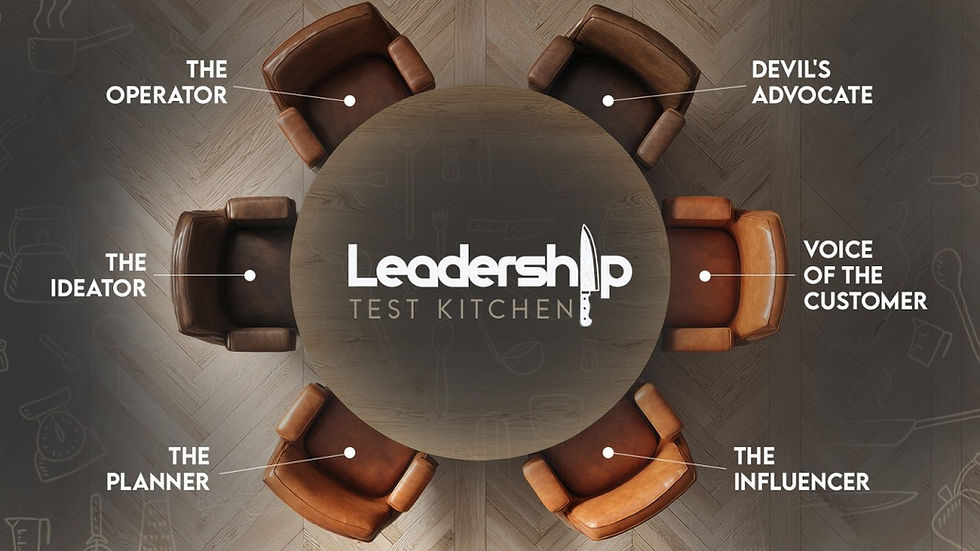
Here’s a little visualization trick I use on myself: I sketch a table in the middle of a blank page and determine who is at the table and in which seat. It keeps me from just relying on my org chart or usual directs. The seats I'm looking for are: the devil's advocate; the voice of the customer; the influencer; the operator; the ideator; and the planner. One person can wear more than one hat, but every persona needs to be represented.
I also get it that sometimes you're limited by the team you have. Rather than viewing it as a constraint, treat it as an opportunity to bring a different voice into the conversation. Fresh perspectives often uncover assumptions the rest of us no longer see.
2. Alignment is a Pull, Not A Push
This is one of the most common mistakes leaders make: believing alignment can be forced. The harder you push, the less you actually get. Real alignment has to be invited, not demanded. Alignment starts with genuinely understanding the interests, needs, and "change platform" of the people you’re trying to bring along. People are much more likely to support a strategy when they believe their perspective has genuinely been heard.
There’s no shortcut for that. It takes face time and listening.
3. Do Your Job, Not Theirs
If I really want my team on board, my job is to sell the what and the why, sometimes the who and the when, and then get out of the how. - That’s their job to run, not mine. Respecting that boundary gives them the room to interpret and shape the idea to fit their reality.
At the same time, be clear that it’s your meeting and your call: you want their counsel and support, but don't relinquish control of the decision-making mantle. And once the decision is made, remember: if you want it done right, leave execution to the people who’ll actually do it.
4. Be A Strong Negotiator
The best negotiators I've worked with share several characteristics.
They know exactly where they're willing to compromise and what their non-negotiables are. They listen with genuine curiosity rather than simply waiting for their turn to speak. They work hard to understand opposing viewpoints before trying to persuade others. And they're constantly looking for solutions that create value for everyone involved.
Just as importantly, they know when to accelerate the conversation and when to adjourn it based on the vibe in the room rather than the clock. None of that happens without preparation.
5. Use Open-Ended Questions to Draw Out Confusion or Dissent
One of my primary goals in any strategy discussion is to surface confusion and disagreement while we're still sitting around the table.
I try to make sure that I'm only doing 30% or less of the talking, that my pockets are full of open-ended questions, and that I let the room generate the other 70%. Then I close by naming what I heard, what I learned, what I decided, and what I need them to do next.
That meeting is important, but it's only the beginning.
The real work happens afterward in one-on-one conversations, small group discussions, walking the halls, reinforcing accountability, monitoring progress, adapting to changing business conditions, and remaining open to the possibility that your original thinking may need to evolve.
A Culinary Note
One of the things I enjoy about cooking is that every meal becomes a chance to learn. Sometimes the recipe works exactly as planned, and sometimes it needs another pass. Either way, the conversation around the table usually makes the next version better. I've found that leading organizations reward that same willingness to listen.
Subscribe to Leadership Test Kitchen to be notified when new editions are released.


Comments