When Your Transformation Agenda Is Too Spicy

Updated: 5 days ago
The Leadership Test Kitchen is a newsletter where I share the ingredients behind leading and growing successful companies. Some editions feature practical frameworks from CEOs who’ve mastered challenges in strategy, culture, and growth. Others share the lessons I’ve learned firsthand as a CEO, or insights I’ve gained from my work with other executives.
September brings a lot of things forward. A new school year. Fall sports. And, for many organizations like mine, annual planning.
You find me a few weeks away from a key leadership retreat designed to kick off our 2027 planning, and I’ve been thinking a lot about how much change we should actually put on the agenda. This question feels especially relevant for us this year.
We’ve been going through a significant transformation of our own. We’ve rebranded and repositioned our company around the human side of business, and formed Ensemble Partners to bring CFO Selections, TheASPTeam, and Valtas together under one parent company.
There are a lot of opportunities in front of us. New markets, new offerings, new ways of working, and new operational initiatives all have merit. The challenge is that we can’t do all of them at once. Resources are finite. Leadership capacity is finite. An organization can only absorb so much change while still running the business well.
So as we head into planning, I’m asking: What is really most important? What can we afford? Are we positioned to deliver it? And who is going to run with it?
Here’s how I’m thinking about those questions.
1. Start with the Long-Term View
I just came off a compelling board conversation about the 5-year direction for our organization. We talked about the numbers, but also about what we want the journey to look like beyond them: our market position, culture, values, operating norms, and customer experience. That longer-term view gives us guiding principles for where we are headed and helps us determine what Year #1 needs to look like.
2. Treat Every Year Like Year 1
Regardless of where I am on a transformation agenda, I tend to think about next year as Year 1. The marketplace changes. Talent changes. Customers change. Our own capabilities change. Rather than simply carrying last year’s plan forward, I start with the conditions in front of us. Given what we know today, what outcomes do we need across growth and profitability? What are the most important things we need to accomplish to get there? That becomes the filter for everything else we might want to put on the agenda.
3. Prioritize the What
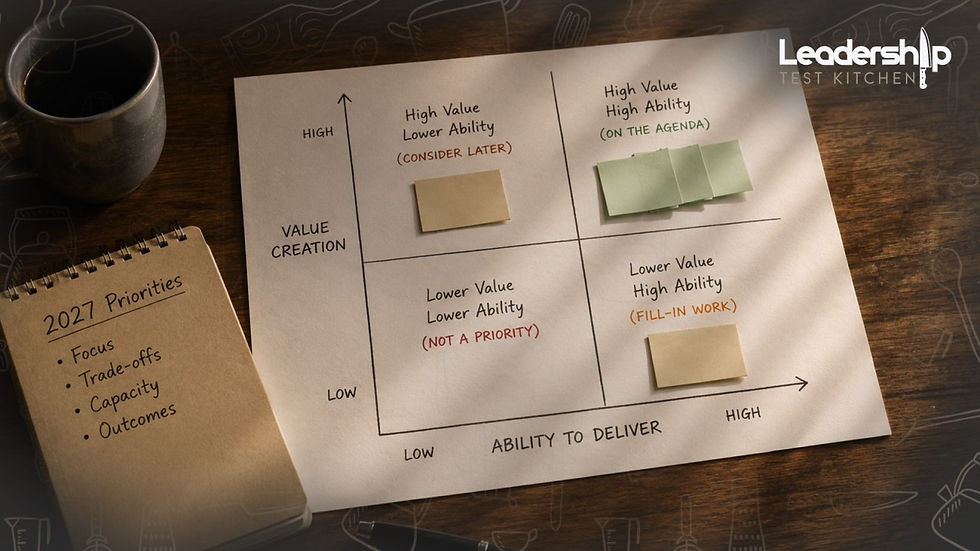
I use a pretty simple 2x2 framework most years. On one axis is our ability to deliver: Do we have the financial resources, talent, operational readiness, and organizational capacity? The other axis is value creation: How much will the initiative contribute to the outcomes we want? This is where good ideas sometimes have to wait. Something can be strategically attractive and still not belong on this year’s agenda. Part of leading transformation is being willing to make that trade-off.
4. Put a Leader Next to Every Priority
This is probably my most practical test of capacity. I match the most important things we want to accomplish to members of my executive leadership team. For every major initiative, I want at least one leader who can confidently drive it. It has to be specific, or it’s easy to convince yourself you have more capacity than you actually do. Then I pressure-test it. If the business outperforms, how does that change my leadership team's capacity to get things done? If we underperform and the core business demands more attention, what happens then? Sometimes the answer is that the list needs to get shorter.
5. Seek Dissonance
I look for some level of debate around what we are going to do in year 1. That tells me we are making trade-offs and being choosy about where we spend our time, talent, and resources. If everything makes the list too easily, we probably haven’t prioritized enough. I’d rather surface that tension in the planning room than discover six months later that we asked the organization to do too much.
6. Leave the How to Your Team
Once we agree on the outcomes and priorities, the team should define the “how.” They know the business better than I do. My role is to provide clarity around the outcomes and guiding principles, then give the people closest to the work room to challenge assumptions and decide how we get there. That ownership becomes especially important when you’re asking people to lead through significant change.
As we prepare for our own planning retreat, I keep coming back to the same tension. We have a lot of options for what to do next. The harder leadership decision is determining how many of those we can do well.
For me, the goal is to identify the changes that matter most, make sure we have the right people to lead those initiatives, and give the organization enough capacity to deliver.
A Culinary Note
Recipes tell you to season to taste for a reason.
You add something, see what it does, and adjust from there. Keep adding without paying attention to what’s already in the pot, and eventually even good ingredients start working against each other. I botched my first recipe in quite a while…it was Ghormeh Sabzi, an Iranian stew. It smelled absolutely amazing in the kitchen and was absolutely awful to the taste – way too much salt.
Transformation agendas can get overloaded the same way.
As we head into planning, the question I’m trying to keep in front of us is a simple one: If we add this, what are we willing to take off the plate?
Subscribe to Leadership Test Kitchen to be notified when new editions are released.


Comments